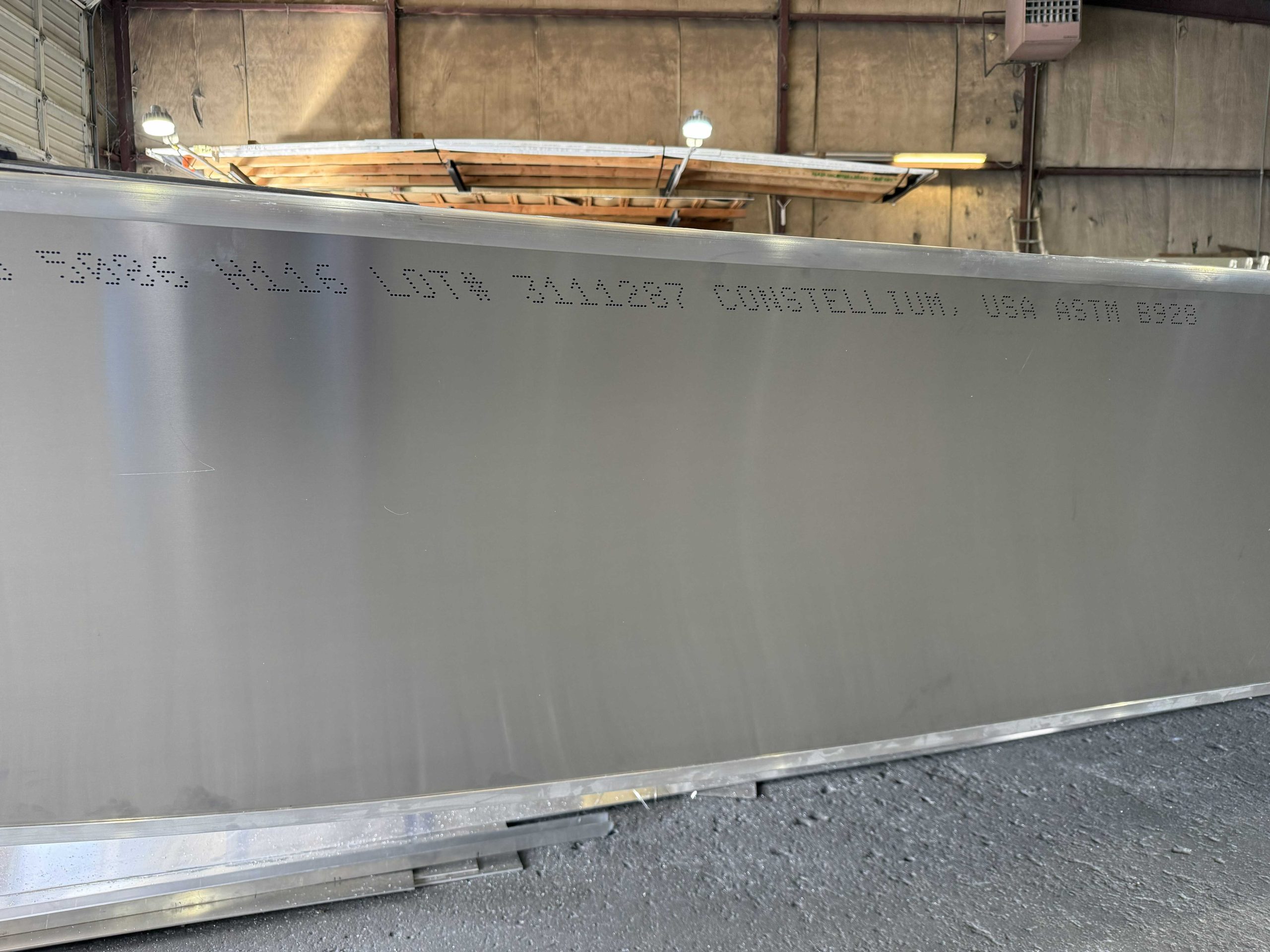
When you’re shopping for an aluminum boat, almost everyone talks about hull thickness. How many people ask which alloy that thickness is made of? Two boats can both advertise a 0.190″ bottom and behave completely differently in the water and over the years — because the metal itself isn’t the same.
At Rogue Jet, we build the entire hull — bottom and sides — from 5086 aluminum. Not 5052 on the sides to save a few dollars. Not a mix. The whole hull. This post explains the difference between 5052 and 5086, and why that decision matters for how your boat performs, lasts, and holds its value.
A quick word on the 5000 series
Both 5052 and 5086 belong to the 5000-series of aluminum alloys, where the main alloying element is magnesium. These are the alloys the marine world relies on because they resist saltwater corrosion well, weld cleanly, and don’t depend on heat treatment to reach their strength — they’re work-hardened, so they stay strong even after the welding torch has touched them.
The key difference between the two comes down to how much magnesium is in the mix, and what that does to strength and durability.
5052 aluminum: a great alloy doing a different job
5052 contains roughly 2.5% magnesium. It’s one of the most widely used aluminum alloys in the world, and for good reason — it forms beautifully, resists corrosion, and is easy to source and work with. You’ll find it in fuel tanks, fabricated brackets, fenders, trailer components, and plenty of light-duty freshwater hulls.
None of that is a knock on 5052. It’s an excellent material for the jobs it’s suited to. The issue is that “easy to form and inexpensive” and “the toughest structural choice for a saltwater hull” are not the same thing.
| 5052-H32 | 5086-H116 | |
|---|---|---|
| Magnesium content (nominal) | ~2.5% | ~4.0% |
| Ultimate tensile strength | ~33 ksi (228 MPa) | ~42 ksi (290 MPa) |
| Yield strength | ~28 ksi (193 MPa) | ~30 ksi (207 MPa) |
| Marine temper available | No dedicated marine temper | H116 / H321, purpose-built for marine |
| Exfoliation/intergranular testing | Not standard | ASTM G66 & G67 |
| Best suited for | Tanks, fab parts, light freshwater use | Structural hulls, saltwater, impact zones |
5086 aluminum: the marine structural standard
5086 carries about 4% magnesium — and that extra magnesium does real work. It produces a notably stronger alloy, with meaningfully higher tensile strength and better resistance to impact, abrasion, and fatigue. Just as important, it holds onto that strength through the heat of welding, where lower-strength alloys give up more in the weld zone.
The headline feature is the H116 (and H321) tempers, which exist specifically for marine service. Alloys in this magnesium range need to be produced and tempered correctly so they resist two long-term saltwater enemies: exfoliation corrosion (corrosion that creeps along the grain structure and lifts the metal in layers) and intergranular corrosion. To prove the material actually resists these, marine 5086 is verified with standardized lab tests — ASTM G66 for exfoliation and ASTM G67 for intergranular susceptibility. That’s the difference between “aluminum that should be fine” and “aluminum that’s been tested for the environment it lives in.”
In short: 5086 gives you a stronger, tougher, saltwater-verified hull at the same thickness — or the same strength at less weight.
Why the entire hull — bottom and sides
Here’s where a lot of builders quietly cut a corner. The bottom takes the obvious abuse, so they build it from 5086. The sides? They’ll use thinner, cheaper 5052 and call it good, because “the sides don’t hit anything.”
Except they do.
- The sides take real punishment. Docks, pilings, gravel beaches, trailer bunks, wakes slapping the chines, the occasional rock you didn’t see. The topsides of a working boat get abused constantly — they’re not just cosmetic.
- Strength should be consistent end to end. A hull is one connected structure. Building the sides from a weaker alloy puts the lower-strength material right where the bottom meets the sides — at the chine, one of the highest-stress areas of the entire boat.
- Fatigue resistance matters everywhere. Pounding through chop flexes the whole hull thousands of times a day on the water. 5086 handles that repeated cyclic loading better than 5052, and you want that resilience in the sides as much as the bottom.
- One alloy means cleaner welds and no weak transitions. When the whole hull is 5086, every seam is the same material welded with the same filler. We weld 5086 with 5356 filler wire, and a single-alloy hull means uniform, predictable weld behavior with no mismatched junction quietly becoming the weak point.
- Uniform corrosion behavior. A hull built from one verified marine alloy ages as one piece, rather than mixing two materials that respond to saltwater and time differently.
Building the sides from a lesser alloy saves the builder money. It doesn’t save you anything — it just moves the compromise to where it’s harder to see.
How we back it up
We don’t ask you to take “marine grade” on faith. Every hull we build starts with certified 5086 plate, and we keep the mill certifications that document the alloy, temper, and that it meets the ASTM G66/G67 corrosion criteria. The same alloy goes into the bottom and the sides, welded with 5356 filler throughout. That paper trail and that consistency are a big part of what you’re actually buying.
What this means for you as an owner
The alloy under your feet shows up in the ways that matter over a boat’s life: it shrugs off the dock rash and beach landings that would dent a softer hull, it stays solid through years of saltwater, and it holds resale value because the next buyer can see — and we can document — that the whole boat was built to one standard. You’re not buying a hull that’s strong in the spots someone expected trouble and thin everywhere else. You’re buying a hull that’s all one thing, done right.
Frequently asked questions
Is 5086 better than 5052 for a boat?
For a structural saltwater hull, yes. 5086 is stronger, more impact- and fatigue-resistant, and available in marine-specific tempers (H116/H321) tested for saltwater corrosion. 5052 is an excellent alloy for tanks, fabricated parts, and light freshwater use, but it isn’t the toughest structural choice for a hull.
What’s the actual difference between 5052 and 5086 aluminum?
The biggest difference is magnesium content — about 2.5% in 5052 versus about 4% in 5086. That extra magnesium gives 5086 higher strength and better durability, and it’s offered in marine tempers verified against exfoliation and intergranular corrosion.
Why does using one alloy for the whole hull matter?
A hull is a single connected structure. Using one alloy throughout keeps strength consistent, simplifies welding (one filler, predictable seams), avoids a weak transition where a lesser alloy meets the high-strength bottom, and means the entire boat ages uniformly in saltwater.
Do the sides of a boat really need a strong alloy?
Yes. Sides take impacts from docks, pilings, trailers, beaching, and wave slap, and they flex with the hull in rough water. They deserve the same impact and fatigue resistance as the bottom.
What filler wire is used to weld 5086?
5086 hulls are welded with 5356 aluminum filler wire, which is matched to the alloy for strong, corrosion-resistant welds.
Is 5086 worth the extra cost?
For a boat meant to work hard and last, the cost difference is small next to the gain in strength, longevity, and resale value — especially when it’s used across the entire hull rather than just the bottom.
Have questions about how we build, or want to talk specs on a custom hull? Get in touch with the Rogue Jet team — we’re happy to walk you through it.