You pull the boat out, back it down the driveway, and give it a good rinse with the garden hose. Job done — right? Not quite. A freshwater rinse is far better than nothing, but it leaves more salt behind than most people realize, and on an aluminum boat that leftover salt is exactly what you don’t want sitting around.
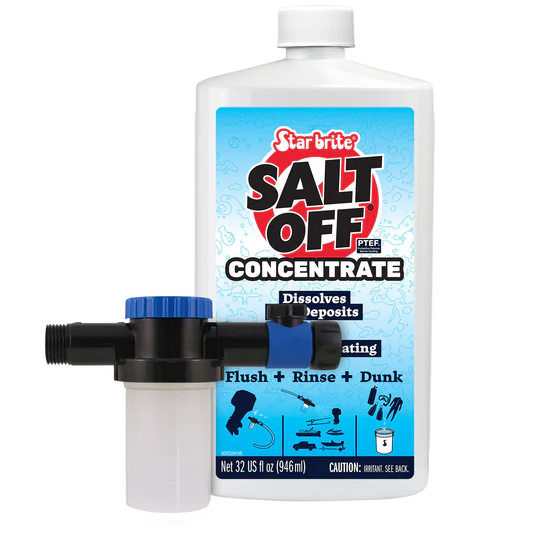
If you run in saltwater, a salt-removing detergent like Salt Off is one of the cheapest, easiest things you can do to protect your investment. Here’s why it matters.
Why salt is aluminum’s enemy
Aluminum is naturally corrosion-resistant because it forms a thin, tough oxide layer on its surface that shields the metal underneath. That layer is the whole reason aluminum boats hold up so well. The problem is that salt — specifically the chloride in it — attacks that protective layer.
Once chloride breaks through the oxide in a spot, corrosion digs in at that point and forms a pit. Left unchecked, that’s how you get the small, dark, pock-marked spots that show up on neglected aluminum. It’s slow, but it’s relentless, and it only happens where salt is allowed to sit.
The trouble with dried salt
Here’s the part that catches people out: when saltwater dries, the water leaves but the salt doesn’t. It stays behind as crystals — on the hull, in the bilge, packed into weld seams and crevices, and tucked under every fitting and bracket.
And salt crystals don’t just sit there harmlessly. Salt is hygroscopic, meaning it pulls moisture out of the air and holds it against the metal. So even a boat that looks bone-dry in the driveway can have damp, salty films quietly working away in every corner. Salt also makes water a far better conductor, which speeds up galvanic corrosion wherever dissimilar metals meet — aluminum hull, stainless fasteners, and so on.
Why a plain rinse leaves salt behind
A freshwater rinse knocks off the obvious surface salt, and that’s genuinely worth doing. But water alone struggles to get salt out of the places that matter most:
- Crystallized salt jammed into weld seams, chines, and tight crevices
- Under fittings, rub rails, deck hardware, and trim where the hose can’t reach
- The bilge, where salty water pools and then evaporates
- Inside the outboard’s cooling passages
- Electrical connections and behind the dash, where salt creep corrodes terminals
Rinse water tends to run right past dried, caked salt without fully dissolving it — and any salt that does redissolve can simply re-crystallize as it dries again.
What a salt detergent actually does
Salt-removing products work differently than plain water. They’re formulated to break down and dissolve salt deposits so the salt actually lets go of the surface and rinses away completely, instead of clinging on or re-crystallizing. Many of them, Salt Off included, also leave behind a light protective film that helps resist the next round of corrosion.
You mix the concentrate with water — usually through a simple applicator that attaches to your hose — spray it on, let it do its work, and rinse. It takes a few extra minutes and a few dollars of product, which is nothing next to what saltwater corrosion costs over the life of a boat.
Where it matters most
When you do treat the boat, hit the spots that take the most punishment:
- The whole hull and topsides — especially weld seams, the chines, and anywhere salt can collect.
- Hardware and fittings — under and around every bolted-on piece, where salt and dissimilar metals meet.
- The bilge — don’t forget the inside of the boat; salt water gets in there and sits.
- The outboard’s cooling system — run a salt-removing flush through it following your motor manufacturer’s flushing procedure. This is one of the highest-value steps for engine longevity.
- Electrical connections — a light treatment helps keep salt creep out of terminals and plugs.
- The trailer — if you dunk it in saltwater, the trailer is corroding too. Rinse and treat it along with the boat, and don’t forget the brakes and hubs.
A simple post-saltwater routine
It doesn’t need to be complicated. After a saltwater run: rinse the boat, motor, and trailer with fresh water to clear the loose salt; apply your salt-removing solution to the hull, fittings, bilge, and trailer; flush the engine’s cooling system per the motor’s instructions; then rinse everything and let it dry. Do that consistently and you’ll head off the slow, expensive damage before it ever starts.
Protecting the boat we built
We build our hulls from marine-grade aluminum and weld them to last for decades — but no aluminum is completely immune to chloride if salt is left to sit on it indefinitely. The good news is that the part you control is simple. A few minutes with a salt-removing detergent after every saltwater trip is the single best habit for keeping your boat, motor, and trailer looking and performing like new for the long haul.
Frequently asked questions
Is rinsing my aluminum boat with fresh water enough after saltwater?
It helps, but it’s not enough on its own. A rinse removes loose surface salt, but it leaves crystallized salt behind in seams, crevices, fittings, the bilge, and the motor. A salt-removing detergent dissolves that salt so it actually rinses away.
Why is salt so bad for aluminum boats?
The chloride in salt attacks the protective oxide layer that makes aluminum corrosion-resistant. Where it breaks through, it causes pitting corrosion — and dried salt keeps pulling moisture from the air, so it keeps corroding even when the boat looks dry.
What does Salt Off (or a similar product) actually do?
It’s formulated to dissolve and release salt deposits so they rinse away completely instead of clinging on, and many formulas leave a light protective film. You mix it with water, apply it, and rinse.
Do I need to flush my outboard after saltwater?
Yes. Salt left in the engine’s cooling passages is a major cause of corrosion and overheating problems. Flush the cooling system after every saltwater use, following your motor manufacturer’s procedure — a salt-removing solution makes it more effective.
Should I treat the trailer too?
Absolutely. If the trailer goes in saltwater, it corrodes right along with the boat. Rinse and treat it as part of the same routine, and pay attention to the brakes and hubs.
How often should I do this?
After every saltwater outing. Consistency is what prevents corrosion — a quick treatment each time is far better than a deep clean once in a while.
Questions about caring for your Rogue Jet, or thinking about a build that’ll spend its life in saltwater? Get in touch with the team.