Step aboard a boat for the first time and it can feel like everyone suddenly switched languages. Someone yells “grab the line!” while pointing at what is clearly a rope. The captain says to look “off the port bow,” and you have no idea which way to turn your head. The bathroom is the “head,” left and right have been replaced by words that sound like wine regions, and the boat’s speed is measured in “knots.”
Here’s the good news: boating jargon only sounds like a secret code. Once you learn a handful of core terms, most of it falls into place — and you’ll go from nodding politely to actually knowing what’s going on. This guide walks a first-timer through the essentials, no prior experience required.
Why boating has its own language
A fair question before we cast off. Most boating terms aren’t there to confuse newcomers, even if it feels that way at first. They exist because, on the water, clarity is a safety issue. “Left” depends on which way a person is facing, but “port” always means the same side of the boat no matter where you’re standing or which way you’re looking. When the wind is up and someone needs to act fast, unambiguous words matter.
Many of these terms are also just plain old — passed down through generations of sailors. So when you learn this vocabulary, you’re picking up a little living history along the way.
Start with the parts of the boat
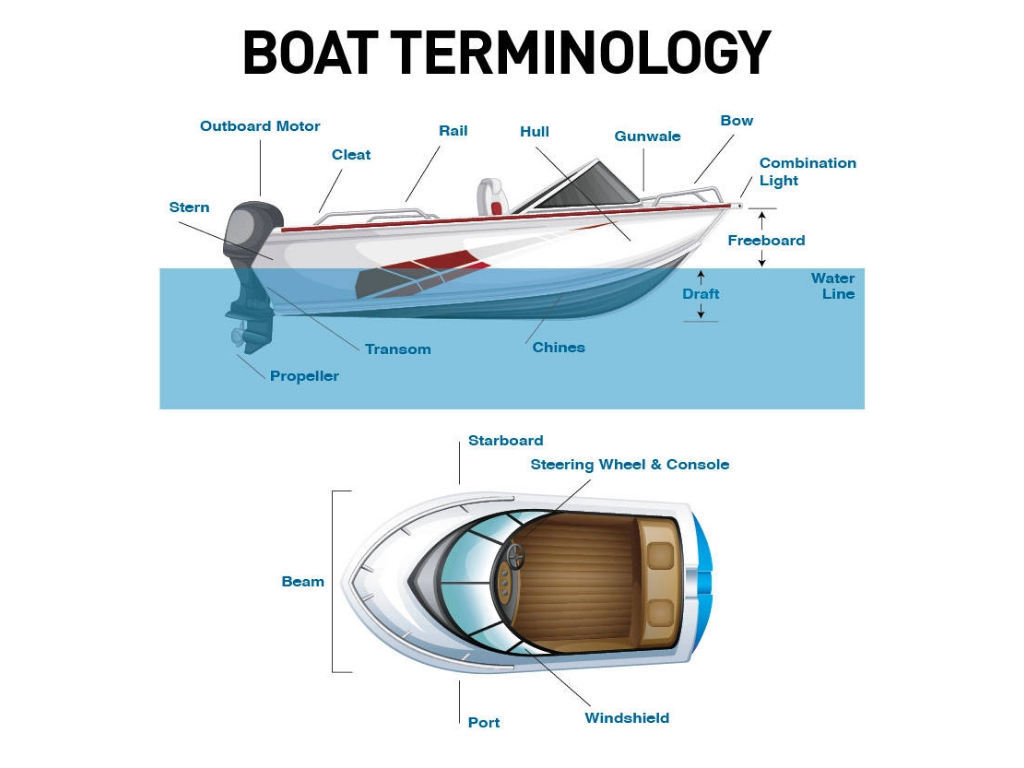
Begin here, because nearly everything else references these. Picture yourself standing on deck, facing forward toward the pointy end.
- Bow — The front of the boat, the pointy end. Rhymes with “cow.”
- Stern — The back of the boat.
- Port — The left side when you’re facing the bow. Easy memory trick: “port” and “left” both have four letters.
- Starboard — The right side when facing the bow. If you remember port is left, starboard is simply the other one.
- Hull — The main body of the boat, the part that sits in the water and keeps everything afloat.
- Deck — The surface you walk on, essentially the boat’s floor.
- Helm — The steering station: the wheel (or tiller) and controls. To “take the helm” is to take over steering.
- Keel — A fin-like structure along the bottom of the hull that adds stability and keeps the boat from sliding sideways.
- Beam — The width of the boat at its widest point.
- Cabin — The enclosed interior space for shelter, seating, or sleeping.
- Galley — The kitchen.
- Head — The bathroom. The name dates back to old sailing ships, where the toilet sat at the bow, or “head,” of the vessel.
- Gunwale — The top edge of the boat’s side, where the hull meets the deck. Confusingly, it’s pronounced “gunnel.”
- Transom — The flat surface across the very back of the stern, where the boat’s name and an outboard motor are often mounted.
Getting your bearings: directions on a boat
Once you know the parts, directions get much easier. These describe where things are relative to the boat itself.
- Fore / forward — Toward the bow (the front).
- Aft — Toward the stern (the back). “Head aft” means move toward the back.
- Abeam — Off to the side, at a right angle to the boat. Something “abeam to starboard” is directly off your right side.
- Ahead / astern — Ahead is in front of the boat; astern is behind it.
- Windward — The side the wind is hitting first; the side the wind comes from.
- Leeward — The opposite, sheltered side; the side the wind blows toward. Traditionalists pronounce it “loo-ard.”
Put it together and “off the port bow” simply means ahead and to the left. Not so cryptic after all.
The navigation terms you’ll actually hear
This is where boating starts to feel like its own science. These come up whenever a boat is finding its way from one place to another.
- Underway — The boat is moving, or at least not anchored or tied up. “We’re underway” means you’ve set off.
- Knot — A unit of speed equal to one nautical mile per hour. “Ten knots” is ten nautical miles in an hour. You never say “knots per hour” — the “per hour” is already baked in.
- Nautical mile — A distance unit used at sea, slightly longer than a land mile (about 1.15 of them). It’s based on the curvature of the Earth, which makes it handy for navigation.
- Heading — The direction the boat is pointing, usually given as a compass bearing in degrees.
- Bearing — The direction to something else (a landmark, another boat) from your position.
- Course — The intended path or direction you plan to travel.
- Wake — The trail of disturbed water a boat leaves behind it. In a “no wake zone,” you slow down so your wake doesn’t rock other boats.
- Draft — How deep the boat sits in the water, measured from the waterline to the lowest point of the hull. A “shallow draft” boat can run in skinnier water without trouble.
- Aground — When the hull hits the bottom — sand, mud, rocks — and gets stuck. To “run aground” is exactly as unpleasant as it sounds.
- Chart — A nautical map. It shows water depths, hazards, channels, and markers rather than roads and cities.
- Buoys and channel markers — Floating or fixed markers that guide boats along safe paths, like road signs for the water.
One classic memory aid for returning to harbor in the U.S.: “red right returning” — keep the red markers on your right (starboard) side as you head back in from open water.
Things people will shout at you
When you’re new, a lot of the jargon arrives as urgent commands. Here are the ones you’re most likely to hear, decoded.
- Line — A rope. On a boat, rope generally becomes “line” once it has a job to do. Calling everything “rope” is a quick way to flag yourself as a newcomer.
- Cast off — Untie the boat from the dock so it can leave. “Cast off the bow line!” means free the rope at the front.
- Make fast — Tie something securely. The opposite of cast off.
- Fender — A cushioned bumper hung over the side to protect the hull against a dock or another boat. Newcomers often call these “bumpers,” which works, but “fender” is the proper term.
- Cleat — A small fitting that lines are tied to, both on the boat and on the dock.
- Fend off — Push the boat away from something to avoid a collision, usually with a hand or a foot.
- Stow — Put something away securely so it doesn’t slide around or go overboard.
A quick-reference cheat sheet
Heading out for the first time? These are the terms worth knowing before you step aboard.
| Term | Plain-English meaning |
|---|---|
| Bow | Front of the boat |
| Stern | Back of the boat |
| Port | Left side (facing forward) |
| Starboard | Right side (facing forward) |
| Helm | The steering station |
| Head | The bathroom |
| Galley | The kitchen |
| Line | A rope with a job |
| Knot | One nautical mile per hour (speed) |
| Underway | The boat is moving |
| Wake | The trail of waves behind the boat |
| Aground | Hull stuck on the bottom |
A few quirks worth knowing
Boating carries some traditions that catch nearly everyone off guard:
- Boats are often called “she.” It’s a long-standing maritime custom.
- You don’t “park” a boat — you dock, moor, or anchor it. Docking ties you to a structure, mooring secures you to a fixed buoy, and anchoring drops a weight to the seabed.
- The floor is sometimes the “sole,” and a wall is a “bulkhead.” The deeper you go, the more everyday words get swapped out.
- “Aye aye” isn’t just pirate-speak. It’s a genuine acknowledgment meaning “I understand and will comply.”
You’ve got this
Nobody expects you to memorize all of this before your first trip out. The fastest way to learn boating jargon is to be on a boat, hear the words in context, and ask questions when you’re unsure — any good skipper would much rather you ask than guess.
Start with the big four: bow, stern, port, and starboard. Get comfortable with those, and the rest gradually falls into place. Before long you’ll be the one casually telling someone to check off the port bow, quietly enjoying the brief look of confusion on their face.
Frequently asked questions
What’s the easiest way to remember port and starboard?
“Port” and “left” both have four letters, so port is the left side when you’re facing the bow (front). Starboard is simply the other side, the right. Both stay fixed to the boat no matter which way you happen to be facing, which is exactly why boaters use them instead of left and right.
Why is a rope called a “line” on a boat?
Once a rope is put to work on a boat — tying up to a dock, raising a sail, securing gear — it’s generally referred to as a line. The word “rope” tends to describe the raw material before it has a specific job. It’s one of the quickest tells of a newcomer, but an easy habit to pick up.
What does “knot” mean when talking about speed?
A knot is one nautical mile per hour. So a boat doing 20 knots is covering 20 nautical miles each hour. Because “per hour” is already part of the definition, you say “20 knots,” never “20 knots per hour.”
Why is the bathroom called the “head”?
The term comes from old sailing ships, where the toilet was located at the bow — the “head” of the vessel — so waste would wash away from the boat. The location changed over the centuries, but the name stuck.
Do I really need to learn all of this before going boating?
No. Knowing bow, stern, port, and starboard will carry you a long way on your first few trips, and the rest comes naturally with time on the water. A good captain expects questions from newcomers and would always rather explain a term than have you guess.
New to boating and thinking about a boat that’ll grow with you as you learn? Get in touch with the Rogue Jet team — we’re happy to walk you through it.