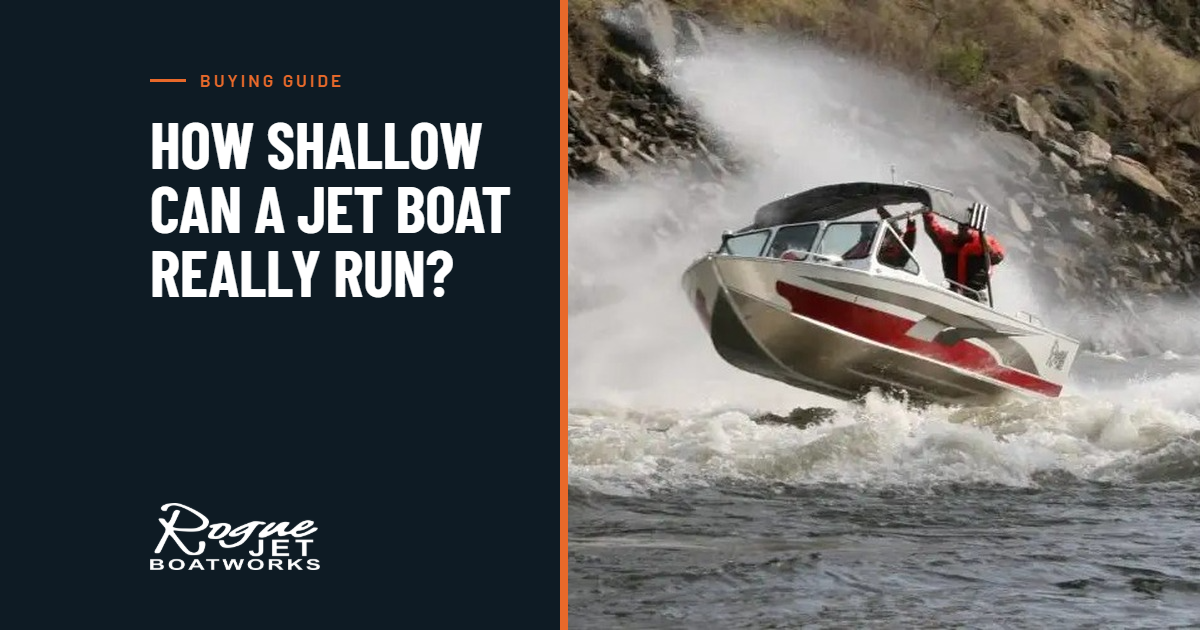
Running shallow water is the reason most people buy a jet boat. But “how shallow can it go?” doesn’t have one number for an answer. It depends on whether the boat is on plane, how much weight it carries, and how it’s built.
Here’s the honest version from people who build these boats and run them on Southern Oregon rivers.
On plane vs. off plane: the big difference
A jet boat has two very different drafts.
On plane, the boat rides up on top of the water. Only the back of the bottom is touching, and the inboard jet’s intake sits flush with the hull. That’s when a jet boat can cross riffles and bars that would stop a prop boat cold. A well-set-up inboard jet can run in just a few inches of water at speed.
Off plane, the boat settles into the water like any other boat. It draws a lot more, and the pump is pulling water from right under the hull. Stop or slow down in skinny water and you can ground the boat or suck rocks and gravel into the intake.
The rule every jet boater learns: in shallow water, keep it on plane. Slow down in deep water, not on top of the bar.
What affects how shallow your boat runs
- Speed. More speed means more lift and less hull in the water.
- Weight. Every passenger, cooler, and gallon of fuel pushes the boat deeper. A boat that skims a riffle empty may not with a full load.
- Weight placement. Too much weight in the stern buries the intake area. Balanced loading keeps the boat flatter.
- Hull design. A flat planing surface ahead of the intake helps the boat lift and keeps the pump fed. That’s why we build our inboard jet hulls with a radius bottom and delta pad.
- Drive type. An inboard jet runs shallower than an outboard jet, because nothing hangs below the hull. More on that in inboard jet vs. outboard jet.
- Pump setup. A pump matched to the boat gets it on plane faster and holds it there. See how we choose a jet pump.
How to read the river
Shallow-water running is a skill. A few basics:
- Follow the main current. The fastest, deepest water usually forms a tongue or V pointing downstream into a rapid or riffle.
- Watch the surface. Smooth, dark water is usually deeper. Choppy, light-colored, or rippled water often means rocks or gravel close to the surface.
- Know that rivers change. High water moves gravel bars. A run that was clean last season may not be this year.
- Run new water slowly first. Scout it on foot or from deep water before running it on plane.
- Go with someone experienced. Riding along with a seasoned river runner teaches more than any article.
If you suck up rocks or debris
It happens to every jet boater. Common signs are a sudden loss of thrust, a rising engine RPM without more speed, or vibration. Get to safe water, shut down, and clear the intake grate. Many inboard jets have an inspection port that lets you reach debris from inside the boat. Ask us to show you yours at delivery.
If it happens often, your impeller and wear ring may be wearing faster. Our jet pump care guide covers what to check.
Build it for the beating
Shallow water means the bottom will touch eventually. We build for that. Our hulls are fully welded 5086 aluminum, and we double the bottom thickness at the stern, where the hits land.
Frequently asked questions
How shallow can a jet boat go? On plane, a well-set-up inboard jet can run in just a few inches of water. Off plane, it needs much more. The exact depth depends on the hull, load, and speed.
Can a jet boat run in a few inches of water? Yes, at speed and on plane. Don’t slow down or stop in water that shallow, or you risk grounding and pulling rocks into the pump.
Is an inboard or outboard jet better for shallow water? An inboard jet. Its intake sits flush with the hull, while an outboard jet’s foot sits below it.
Why does my jet boat lose power in shallow water? Usually the intake is pulling air, gravel, or debris. Get to deeper water, shut down, and clear the intake grate.
Does weight affect how shallow a boat runs? Yes. More weight means more draft, both on and off plane. Balanced loading helps.
Find the right boat for your river
Tell us where you run and how you load your boat, and we’ll recommend a setup that fits. Call 541-826-5400 or send us a message.